
Your cart is currently empty
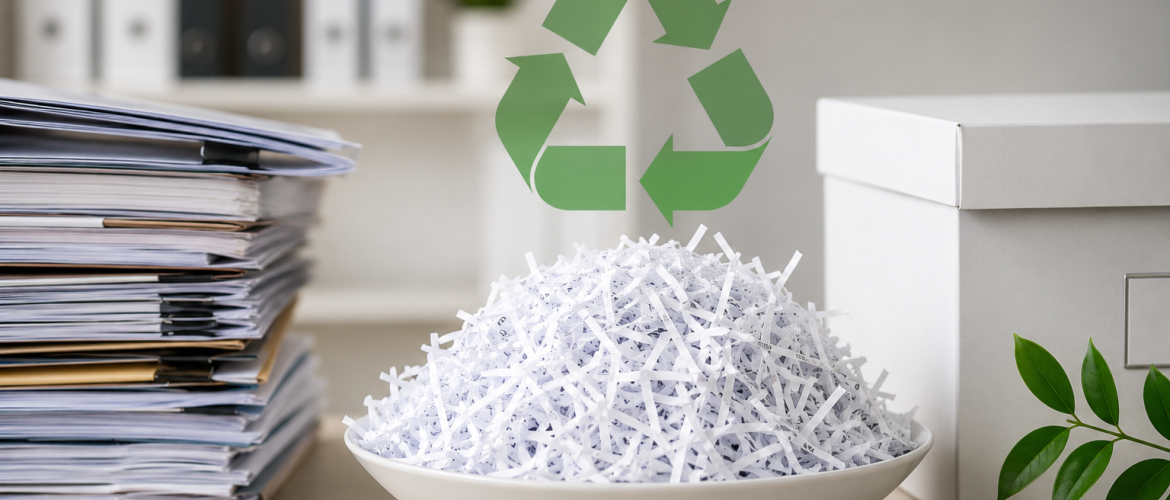
Document destruction: From confidential information to recycled material
Reading time: approximately 10 minutes
In companies, document destruction is often perceived as the end of a document's life cycle. The paper is shredded, the information is no longer readable, and it seems that the process has concluded with that.
However, in reality, the end of a document's life cycle is somewhat broader.
Before destroying a document, it must be verified whether it is allowed to be destroyed at all. During destruction, the protection of the information contained in the document must be ensured. Meanwhile, after safe destruction of the document, the paper itself can continue its lifecycle in a completely different role — as a material for recycling.
Therefore, document destruction is not just a way to free up space in the archive. It is part of a broader document and information management process where information security, compliance with regulatory requirements, and responsible resource use intersect.
In this article, we will look at what happens to documents after they are removed from circulation, why shredding and paper recycling are not the same process, and how a document's life cycle continues after the information contained in it is no longer needed.
The document lifecycle does not end with archiving
The document life cycle begins the moment a document is created or received. It is used in the company's daily operations, systematized, and stored for as long as necessary for the specific purpose or as required by applicable regulations.
However, archiving is not automatically the final stage of a document.
The time comes to evaluate the further retention of the document. If the document still has legal, administrative, practical, or archival value, its retention continues. On the other hand, documents whose retention period has expired and for which there is no longer any other basis for preservation may be selected for destruction in accordance with the applicable procedure.
In the Archives Law, the destruction of a document is defined as destruction of untraceable information or its storage medium. That very precisely describes the essence of the process: the purpose of document destruction is not simply to reduce the amount of paper, but to ensure that the information can no longer be used.
INFOGRAPHICS
Document lifecycle
📝
Creation
➜
💼
Use
➜
🗄️
Archiving
➜
🔎
Evaluation of the deadline
↓
✅
Turnip storage
✂️
Safe destruction
↓
♻️
Recycling
FACTS
Document destruction is not the same as document disposal.
The purpose of destruction is to irreversibly eliminate the information contained in a document or its medium.
The purpose of destruction is to irreversibly eliminate the information contained in a document or its medium.
What actually happens during document destruction?
In the case of paper documents, secure destruction is based on the physical transformation of the document into a form where the originally contained information is no longer practically usable.
Most commonly, this is achieved through mechanical crushing.
However, in terms of information security, it is not just the few seconds during which the document passes through the shredder that matter. The entire process is important — the storage of documents prior to destruction, access control, document transport, the destruction itself, and the documentation of the process.
In the model used by Shrederia, document destruction takes place on the client's premises, and the company's website indicates the DIN 66399 P-4 security level, as well as the issuance of a certificate after the service.
However, regardless of the chosen service provider, the principle is the same: Confidential information must be protected until it is properly destroyed.
Why can't documents simply be thrown into the waste paper?
Here, it is essential to distinguish between two actions — destruction of information and material recycling.
Placing paper in a wastepaper container does not in itself make the information contained in the document inaccessible. If the document ends up in the container in a complete and legible form, it still contains the same personal data, financial information, contract terms, or commercial information that it did before disposal.
Therefore, in the case of confidential documents, the correct order is the reverse: first, the possibility of using the information contained in the document must be prevented, and only then may the material continue on its way into the recycling cycle.
This principle is also important in the management of personal data. The GDPR establishes the principle of storage limitation – personal data must not be kept in a form which permits identification of data subjects for longer than is necessary for the purposes for which the personal data are processed, except as provided for in the regulation. This does not mean that every document must be automatically destroyed after a certain period of time; first, other legal obligations and the applicable retention period for the document must also be taken into account.
PRACTICAL EXAMPLE
During the annual archive review, the company discovers a set of documents whose specified retention period has expired and for which there is no other basis for further retention.
The documents contain former client data, contract information, and internal company information.
If these folders were simply placed in a paper recycling container, the information inside them would still be readable. On the other hand, if the documents are first properly destroyed and only then does the shredded material enter the recycling cycle, the two goals of the process are clearly separated.
First, information protection
→
then the reuse of the material.
→
then the reuse of the material.
Can a shredded document be restored?
It depends on the disposal method used.
If a paper document is simply torn in half or cut into a few large pieces, the content of the document is not necessarily permanently destroyed. The fragments can theoretically be put back together, and some of the information may remain legible.
That is precisely why specific security levels and shredding methods are used in document destruction. The more sensitive the information, the more essential it is to choose an appropriate destruction solution for it.
Furthermore, after physical shredding, the paper's journey can continue. In the recycling process, the paper is converted into pulp and loses the physical structure of the original document.
What happens to shredded paper?
Here begins the part of the document life cycle that often remains invisible.
After secure document destruction, the paper itself does not always become worthless waste. The information contained in the document has been destroyed, but the material can still be used as a secondary raw material.
The shredded paper is passed on into the recycling cycle. Depending on the material quality, sorting requirements, and the specific recycling chain, it can be prepared for the further use of paper fibers.
During the recycling process, paper is converted into pulp, cleaned of impurities undesirable for recycling, and prepared for reuse. Depending on their properties and the specific recycler's technology, the resulting fibers can be used in the production of new paper and cardboard products.
One nuance is essential here: It is incorrect to claim that documents destroyed by a specific company always turn into a certain final product.. Recycling chains, material flows, and production technologies differ.
Therefore, it is more accurate to talk about returning the material into the recycling cycle.
INFOGRAPHICS
Document path after destruction
📄
Document
Data carrier in company operations.
➜
✂️
Safe destruction
Information is permanently removed from circulation.
➜
📦
Shredded paper
The material no longer performs the function of a document.
➜
♻️
Recycling loop
Paper is being prepared for further recycling.
➜
🔄
Recycled raw material
Paper fibers can be used in the production of new materials and products.
Document destruction and the circular economy
At this very point, two initially distinct goals meet: information security and resource reuse.
From an information security perspective, the company's goal is to ensure that information for which there is no longer a justified need to remain in circulation does not become accessible to unauthorized persons.
From a material management perspective, however, there is no need to destroy the value of the paper fiber itself just because it once contained confidential information.
Therefore, both processes can follow one another.
First, the information is destroyed. Then, the material is used.
This approach allows viewing the end of a document's life cycle not just as waste generation, but as a controlled transition from an information carrier to a material that can be returned into circulation.
💬
EXPERT COMMENTARY
The document's lifecycle must be concluded as carefully as it is initiated
In companies, a lot of attention is paid to how documents are properly created, classified, and stored. However, managing the end of a document's lifecycle is just as crucial.
Secure destruction means more than just shredded paper—control over the document until the moment of destruction, the choice of appropriate destruction methods, and transparent documentation of the process are also important.
Why does documenting the destruction process matter?
It may be important for a company not only to know that documents have been physically destroyed, but also to be able to prove that the process took place.
This is particularly relevant in organizations that operate information security, quality management, personal data protection, or other internal control procedures.
For example, after several months or during an audit, a question may arise about what happened to a certain set of documents selected for destruction. In the case of a documented process, it is easier for the organization to justify the actions taken.
At the same time, it is important not to confuse a destruction certificate issued by a service provider with a legal authorization to destroy documents. The specific organization must first ensure on its own that the respective documents are permitted to be destroyed.
This is particularly important for institutions within the meaning of the Archives Law. The current regulatory framework provides them with specific document evaluation and archive management duties, whereas since 2024, the procedure for document and archive management is regulated by Cabinet of Ministers Regulations No. 282.
Most common misconceptions
“If the document is no longer needed, it may be destroyed.”
Not always. The fact that a document is no longer needed for daily work does not mean that its prescribed retention period has expired or that there is no other legal basis for keeping it.
“The waste paper container is the same as secure destruction.”
No. These processes have different primary objectives. The task of secure destruction is to make information permanently inaccessible, whereas the task of recycling is to recover material for reuse.
“The longer documents are kept, the safer it is.”
This is not a universal principle either. In the case of personal data, the GDPR storage limitation principle must be taken into account, whereas in other cases, longer document retention may be required by laws and regulations or another justified purpose.
“After shredding, the paper has no value anymore.”
Not mandatory. If the shredded paper meets the relevant recycling requirements, it can enter the recycling loop and become a raw material for future production.
But what happens to digital data carriers?
Today, the lifecycle of documents and information is not limited to paper alone.
Company information is also located on HDDs and SSDs, USB flash drives, optical discs, memory cards, and other data storage media.
The core principle is similar: when there is no longer a basis for storing information, it must be ensured that it is no longer available.
However, the technical solution can be completely different. Deleting a file or formatting a device is not the same as physical destruction of the storage media. Therefore, the method of information removal must be chosen according to the media technology, information sensitivity, and the organization's security requirements.
That is a separate issue worth looking at in more detail in another article.
Frequently asked questions
May all documents be destroyed after their retention period expires?
Not automatically. It is necessary to evaluate the type of document, the applicable regulations, the retention period, the potential archival value, and other legal or practical reasons for keeping the document.
Does paper recycling automatically mean secure document destruction?
No. These are different processes. In the case of confidential information, secure destruction of the information must be ensured first, and only then can the material be passed on for further recycling.
What happens to paper after shredding?
If the material is suitable for recycling, it can enter the recycling loop. The paper fibers are prepared for reuse and can serve as a raw material for new paper or cardboard products.
Does the GDPR set one specific personal data retention period?
No. The GDPR does not provide a single universal retention period for all personal data. The Regulation stipulates that identifiable personal data shall not be kept longer than necessary for the purposes for which it is processed, while taking into account the exceptions provided for in the Regulation and other applicable legal obligations.
Why is it necessary to document destruction?
This helps maintain a transparent document lifecycle and, if necessary, prove that a specific set of documents has been withdrawn from circulation. The specific documentation requirements depend on the organization, the documents, and the applicable regulations.
In conclusion
Question “What happens to documents after their destruction?” is broader than it might initially seem.
The document lifecycle does not end the moment it is removed from the archive. First, it must be determined whether the document may be destroyed. Then, it must be ensured that the information contained within it is permanently removed from circulation. Meanwhile, the paper itself, after secure destruction, can continue its lifecycle as recyclable material.
Thus, at the end of the document life cycle, three areas important to the company converge: document management, information security, and responsible resource use.
The most important principle is relatively simple: documents should not be stored without a justified necessity, but they should also not be destroyed just because they are no longer needed for daily work.
First comes evaluation. Then — safe destruction. And after that, the material can return into circulation.
Related article
What is the cost of storing unnecessary documents in a company?
Applied regulatory enactments and sources
Archives Law. (2010). Laws of the Republic of Latvia. Likumi.lv.
European Parliament and Council of the European Union. (2016). Regulation (EU) 2016/679 of the European Parliament and of the Council of 27 April 2016 on the protection of natural persons with regard to the processing of personal data and on the free movement of such data (General Data Protection Regulation). Official Journal of the European Union, L 119, 1–88.
Cabinet of Ministers. (2024). Document and Archive Management Regulations (Cabinet Regulation No. 282). Likumi.lv.
International Organization for Standardization. (2016). ISO 15489-1:2016 Information and documentation — Records management — Part 1: Concepts and principles. ISO.